Sasang Constitution Feng Shui

Feng shui
for the person

The same house calls for a different prescription when a different person lives in it. Sasang Constitution Feng Shui reduces and adds materials, color, light and scent according to the constitution of the people who live there.

Space that knows who lives in itOriginal concept Dr. Yim DongKoo · Korea Constitution Life Institute
01 · Concept

People
before
houses

Traditional living feng shui centres on the arrangement of a place and the harmony of yin, yang and the five elements. Yet people, too, carry an energy of their own into a space. We read that person through the Sasang constitution.

We read constitution and sensibility through Sasang medicine, a distinctly Korean tradition that began with Lee Je-ma's Dongui Suse Bowon (1894), and we use the generating and controlling cycles of the five elements as a symbolic language for prescribing space. The interior becomes a tool that guides a person toward a state of harmony: a person of balanced yin and yang (陰陽和平之人).

Traditional living feng shui
Sasang Constitution Feng Shui
FocusThe arrangement of a place, its surroundings, yin-yang and the five elements
FocusThe constitution and daily life of the person who lives in the space
Reading the personMethods such as Eight Mansions derive a personal direction from birth year and sex
Reading the personSasang constitution: relative organ size, temperament, sensory preference
EvaluationInterpretive standards of each school
EvaluationThe comfort, preference and usability the resident experiences
02 · Principle

Empower strengths,
support weaknesses

木Tae-eum · Liver
土So-yang · Spleen
金Tae-yang · Lungs
水So-eum · Kidneys

A constitution's element is the element of its large organ (liver, spleen, lungs, kidneys). Tae-eum: large liver, small lungs. So-yang: large spleen, small kidneys. So-eum: large kidneys, small spleen. Tae-yang: large lungs, small liver. Because the Sasang constitution divides people by these four organs, 火 (the heart) is not addressed.
Generating cycle 木→火→土→金→水 · Controlling cycle 木→土→水→火→金 · The constitution-element correspondence is not the orthodox doctrine of the original Sasang system; it is Dr. Yim DongKoo's interpretive model for carrying the Sasang constitution into space.

1Reduce (瀉) what is strong

A person already brings the energy of the large organ with them. Piling it up in the space as well tips it into excess, so we take some away.

2Supplement (補) what is weak

We fill in the energy of the small organ through material, color and scent to restore balance.

3Empower the strength

We add the energy that generates the native element, so the strength comes through well without overflowing.

4Support without excess

If the supplementing energy controls the native element, keep it subtle. Filling a weakness should never break a strength.

The five elements are a symbolic language of color, form and material, not rules that forbid real materials. Structural, fire, ventilation and accessibility standards come first. The prescription is a starting point; the final judgement is the resident's comfort.

03 · Four Rooms

Four constitutions,
four faces of a room

Scent

The full prescription for each constitution (reduce · supplement · empower) is in the guidebook.

The accent colors are the constitution reference colors (PANTONE) proposed in Dr. Yim DongKoo's 2021 constitution manuscript. For So-yang and Tae-yang they directly supplement the weak organ; for Tae-eum and So-eum they coincide with the color that generates the weak organ (an observation by the Institute, pending Dr. Yim's review).
04 · Method

Five steps

  1. Constitution assessment

    A Sasang constitution questionnaire (such as KS-15) and expert consultation, together with preferences for light, sound and touch.

  2. Five-element space audit

    For each room, materials, colors, forms, lighting and scent are classified by element and their proportions recorded.

  3. Prescription design

    Decide what to reduce, supplement and empower, then choose the accent color and scent.

  4. Styling

    Start with small surfaces (objects, scent, artwork) and widen to large ones (floors, walls, furniture).

  5. Living review

    After two and four weeks, record sleep, fatigue, focus and mood, and adjust.

When a family lives together, keep the four elements evenly balanced in the living room and kitchen, leaning slightly toward the majority constitution; bedrooms and studies follow the prescription of the person whose room it is.

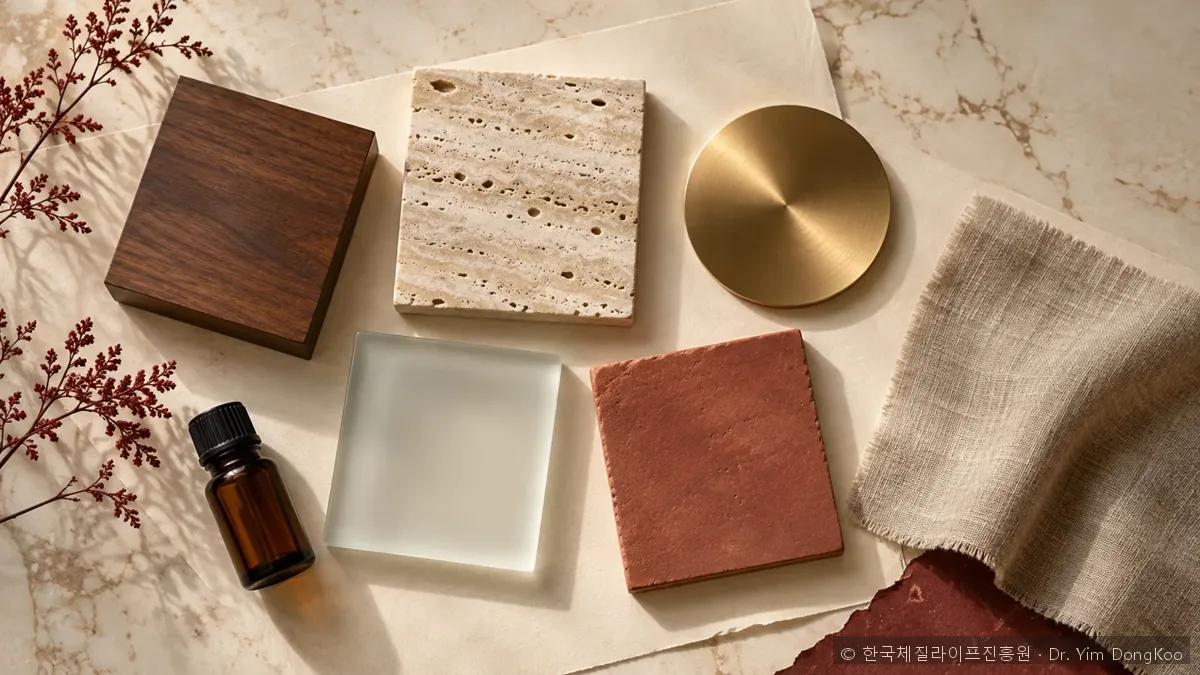
Samples of solid wood, travertine, brass, glass, terracotta, linen and aroma oils
05 · Interior & Objects

Five-element
design lexicon

In the end, a prescription is carried out through objects. Here is how the four energies appear in color, material and form. 火 (lighting, red) is treated as a baseline condition rather than a constitutional prescription.

ElementColorMaterialFormObjects & elementsLight & texture
木Green, tealSolid wood, bamboo, rattan, linenTall columnar shapes, stripesTall plants, wooden shelvesNatural light, matte grain
土Yellow, ochre, beige, terracottaCeramics, clay and lime walls, limestoneLow, wide rectanglesCeramic vases, low tables, rugsSoft diffused light
金White, gray, silver, goldBrass, steel, white marbleCircles, archesRound mirrors, metal framesReflected light, smooth surfaces
水Black, navy, deep blueGlass, mirror, high gloss, waterWaves, curves, irregular formsWater basins, ink-wash paintings, glass vasesDeep tones, soft shadows

Aroma and diffusers

Build around the constitution's reference oil and blend with lavender, tea tree and lemon. We recommend ultrasonic diffusers or reed diffusion over synthetic air fresheners and burning candles, used intermittently: 30 to 60 minutes on, then a rest. In spaces with infants, pregnant women or pets, check oil types and concentrations separately.

06 · Application

From home
to Milan

Residence

Townhouses · Apartment complexes

A family constitution assessment before move-in, followed by a space prescription for each household. Bedrooms follow their owner's constitution; living rooms are tuned for family harmony.

Exhibition

Milan Design Week 2027

WHO AM I SPACE (working title, in planning): a participatory Korean pavilion where visitors discover their constitution, try adjusting a space, and take home a prescription card.

Hospitality

Spas · Cafés · Hotels

A space prescription standard extending from constitution spas and constitution cafés to guest rooms and corporate lounges.

Request the guidebook
07 · References

Sources

  1. Lee Je-ma, Dongui Suse Bowon (1894): the theory of relative organ size in Sasang medicine
  2. Yim DongKoo, "Constitution Manuscript Notes" (2021, Constitution Life Curation): constitution reference aromas and reference colors
  3. Ryu JeongKun, "Constitution Aromatherapy" manuscript (2021): signature oils and blending principles by constitution
  4. Yim DongKoo, constitution book, chapter 2-13, "Living Feng Shui for Your Constitution"
  5. A study of harmonious and disharmonious colors by constitution type (master's thesis)
  6. Conversations with Dr. Yim DongKoo, 2026-10-20 · 2026-10-24

This site is a lifestyle proposal that connects the Sasang constitution lifestyle with spatial design. The space prescriptions by constitution are design interpretations, not clinically validated prescriptions. The value of a space is confirmed through comfort, preference and usability, and it does not replace the diagnosis or treatment of illness. The name of the methodology is a working title.